Mr Ramsay
To the LighthouseMr Ramsay is a philosopher, husband, and father whose search for intellectual certainty is shadowed by self-doubt and an acute need for sympathy. He can face the limits of knowledge with austere honesty, yet depends on others to steady him when he fears his work will fail to endure. This tension defines both his domestic authority and his isolation: the man who insists on hard facts also longs to be taken into the warmth of family life.
Identity and Intellectual Temperament
Mr Ramsay treats truth as an obligation, even when it wounds. When James hopes that the weather will permit the family’s long-awaited expedition, Mr Ramsay interrupts the prospect with the blunt forecast that it will not be fine. His statement is accurate, but its timing makes accuracy feel like an act of power: to James, the correction extinguishes anticipated joy, while Mr Ramsay takes satisfaction in refusing to soften an unpleasant fact. He regards this severity as preparation for a difficult life, in which courage and endurance matter more than consolation.
The narrative gives his mind a distinct scale and shape through the alphabet. Mr Ramsay has advanced, one letter at a time, to Q, a point he considers a real intellectual achievement; R lies just beyond his grasp, while Z glimmers as a rare summit reached by perhaps one person in a generation. He knows Q and believes he can demonstrate it, but cannot securely establish what comes next. His crisis is therefore not a lack of intelligence but the felt boundary of what intelligence can prove: he braces himself and turns to endurance, justice, foresight, devotion, and skill as he tries to advance from Q to R.
That inward labor is set against a recurring image of exposure. Mr Ramsay walks through familiar lanes dense with remembered history, then reaches the edge of the lawn and looks over the bay. There he seems stripped of the gestures and accomplishments that ordinarily accompany him, standing alone on land the sea is slowly consuming. The scene gives his intellectual uncertainty a physical counterpart: beneath human knowledge is a darkness that cannot be mastered, and even the ground on which one stands is being taken away. His austerity can inspire reverence as well as pity, because he appears to accept the burden of looking steadily at that uncertainty.
Authority, Sympathy, and Family Life
At home, Mr Ramsay’s authority reaches his children before he needs to act. James hates him for interrupting the shared quiet with Mrs Ramsay and for demanding attention through his gestures and emotion. The boy’s hostility gathers around Mr Ramsay’s exactness, egotism, and insistence on being heard; it is not simply disagreement over the weather, but resistance to a father who can turn his own feelings into the household’s immediate obligation. James tries to reclaim his mother’s attention by fixing his eyes on the page, but Mr Ramsay remains there, asking in effect for sympathy.
Mr Ramsay’s need is explicit when he calls himself a failure. He wants Mrs Ramsay to recognize his genius and restore him to the circle of life, where he can feel warmed and soothed rather than barren and excluded. Her response is practical and emotional at once: she continues knitting, flashes her needles, and offers Charles Tansley’s name as reassurance, but Mr Ramsay needs more than a brief answer. The contrast between his appeal and her sustaining domestic activity exposes the emotional labor beneath their marriage. He looks to her for the assurance that his intellectual existence belongs within a living household.
His dependence does not prevent him from withdrawing into solitude. After the effort of thought, he can recover privacy by lighting his pipe and looking toward his wife and son in the window without distinguishing either of them as individuals. Their presence confirms and fortifies him, even as he returns inward to his problem. In another solitary moment by the sea, he turns from the immensity of human ignorance and finds comfort in the fact that he has a wife and children. He is, he admits to himself, mostly happy, though the consolation of ordinary life seems small beside the vast questions that have occupied him.
This contradiction makes his family both a source of genuine attachment and a refuge from thought. He can see his wife and son together as vulnerable, and imagine that they need his protection; but their ordinary presence also steadies his sense of himself. The novel does not reduce either side to a single motive. His concern can be real, while his expectation that others will answer his emotional needs makes intimacy demanding for those around him.
Self-Doubt and Public Life
Mr Ramsay’s insecurity becomes especially visible in company, where talk of literary reputation threatens to turn into a judgment on his own work. During a discussion at dinner, Mrs Ramsay anticipates that questions about what lasts will make him wonder whether his books will be read. William Bankes answers that he attaches little importance to changing fashions and urges the company to enjoy what it enjoys; Mr Ramsay responds irritably that Scott, or perhaps Shakespeare, will last him his lifetime. Mrs Ramsay reads the irritation as evidence that he wants someone to reassure him that his own work will endure.
His vulnerability also appears in the small irritations that punctuate the dinner. When Augustus Carmichael asks for another plate of soup after Mr Ramsay has finished, Mr Ramsay’s anger rises sharply. He manages to restrain himself and says nothing, yet wants Mrs Ramsay to notice that he has held back. The episode places self-command beside the demand for recognition: even silence can become something for which he expects credit. Mrs Ramsay’s watchfulness helps keep the moment from becoming an open disturbance, while her awareness of his needs shapes how she reads the talk around the table.
Later, she finds him absorbed in a book by Sir Walter Scott. She understands that Charles Tansley’s assertion that people no longer read Scott has unsettled Mr Ramsay because he can test the claim against Scott without accepting its implication for himself. His own books remain the more painful question: whether they will be read, whether they are good, and what others think of him. Reading Scott therefore becomes more than a choice of book; it is a way of approaching the threat to his reputation at a safer remove, without resolving the anxiety that produced it.
Bereavement and the Lighthouse Journey
Mrs Ramsay’s sudden death changes the meaning of Mr Ramsay’s reaching gestures. In the house’s dark passage, he stretches out his arms, but the person who might have answered them is gone, and they remain empty. The surrounding account moves from the turbulence of the nights and sea to the abandoned house, where locked rooms, bare boards, and the objects left behind preserve traces of lives no longer present. Mr Ramsay’s loss is thus set within a larger undoing: the home that had held his family is exposed to time and weather, and private grief has no power to command either.
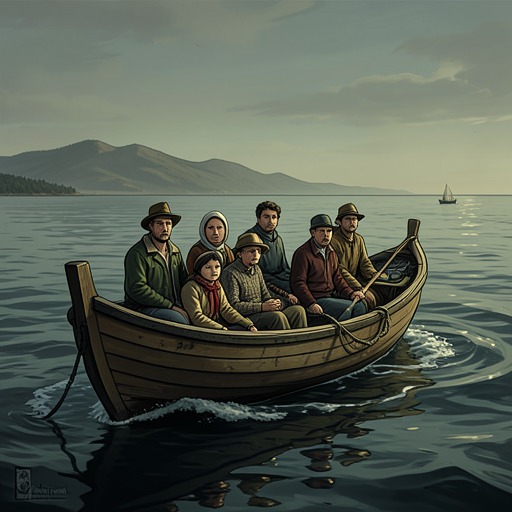
On the later boat journey, bereavement becomes a role Mr Ramsay consciously stages for himself. Seeing the house from the water, he imagines himself on its terrace, old and bowed, and presents himself inwardly as a desolate, widowed man. He summons an imagined audience of women who will pity and soothe him, recognizing in that fantasy the pleasure he takes in women’s sympathy. The moment does not cancel his grief; it reveals how grief, self-dramatization, and the desire for comfort can occupy the same mind. His mourning is real, but he also shapes it into a scene in which his suffering might be recognized by others.
The boat’s movement away from shore makes the loss visible to Cam as well: the house becomes distant and strange, and she can no longer tell which one it is. Mr Ramsay, by contrast, finds it and sees himself there, alone on the terrace. The difference in their perspectives underscores the separation between his inward drama and the children’s experience of the world receding from them. His bereavement remains bound to the family home, while the journey carries the children toward a new encounter with their father.
Reconciliation and Narrative Significance
Near the journey’s close, Mr Ramsay praises James for steering the boat like a born sailor. The recognition matters because it answers a desire James has carried for years: Cam understands that her brother has finally received the praise he wanted. James does not openly share his pleasure; sitting upright at the tiller, he keeps his face guarded and acts as though he is indifferent. His composure conceals the force of the moment, while Cam silently recognizes that the father’s words have reached him.
The praise marks a change in their relationship without erasing its history. James’s early hatred was sharpened by Mr Ramsay’s bluntness and his intrusion into the intimate space between mother and son; now the father acknowledges the son’s competence in the very act of steering them forward. The change is small in outward form—a few words of approval—but decisive in emotional weight because it gives James what his father’s authority had long withheld. The son’s restrained response keeps the reconciliation from becoming easy or sentimental: the pleasure is his, and he does not have to perform it for the others.
Mr Ramsay’s character is held together by tensions the novel refuses to resolve into a single judgment. His commitment to fact can be courageous and cruel; his intellectual seriousness coexists with fear that his work will be forgotten; his need for sympathy strains his family even as he depends on its presence. After Mrs Ramsay’s death, he is at once bereft and drawn to imagine the consolation others might offer. On the water, however, his praise gives James a form of recognition that his earlier domestic authority could not provide. The journey’s final emotional movement is therefore not a triumph over grief or uncertainty, but a belated connection made possible by an act of acknowledgment.